In 1967, a man by the name of Wilhelm Olaf Meyer was tasked with designing a building that would transform a largely agricultural population into a class of collegiate and intellectually inclined people. The building was to be grand and austere, and it was to “make a statement about its patrons who had just arrived in the city”. I am, of course, referring to the main campus of the Randse Afrikaanse Universiteit, better known as the University of Johannesburg.
At the height of Afrikaner Nationalism, the ruling party in 1955 commissioned the establishment of an Afrikaans medium tertiary institution so as to tap into the intellectual potential of Afrikaners who came from families that historically migrated to the city from the countryside after their decimation from the Anglo-Boer War.
These were people who (due to urban absorption that did not accommodate Afrikaans speakers) were anglicised and therefore did not grow the Afrikaner culture substantially, leading to conformity to the prevalence of Western ways of doing life. Because most Afrikaners spoke little to no English and no higher education institution provided any curricula in Afrikaans, Afrikaners were subsequently excluded from qualifying to work in professional fields such as Finance and Law, which would then stunt their socio-economic growth. For the vanguards of Afrikanerdom in the National Party, this was a cause for concern.
It was then decided that a university, built from the ground up with the Afrikaner in mind, had to be built to address this very concern.
After the approval of Parliament in 1955, the Randse Afrikaanse Universiteit was established, and the inaugural cohort of students “squatted” at the Braamfontein brewery while the campus was being built. About a decade later, a large piece of land was purchased from the Johannesburg Country Club, and the construction of RAU’s official campus began. 8 years of complex labour followed, and the most aspirational building in South Africa at the time was complete: the Rand Afrikaanse Universiteit Kingsway Campus. It was so grand that the scale of its construction was compared to the Union Buildings built in 1910! The new university made generous use of Brutalism and, given the socio-political context it was built in, has been described as “expressive of authoritarian 1970s Afrikaner nationalism”.
It was also described as cutting-edge as it took its place as one of the biggest Brutalist structures in the world at the time, and despite its gargantuan price tag of R41 million, it received positive press worldwide with British architect-writer Theo Crosby describing it as “splendid: far better than any British equivalent, perfectly modern, logical but with a sense of place and, in the corridors, a Piranesian grandeur”. It seemed that the vision of the inaugural chancellor and the entire Afrikaner political class had been realised, as there was now a world-class matrix on the Witwatersrand built for the betterment of the young Afrikaner.
This article aims to briefly explore the potential of campus architecture and its use in South Africa, its informants and how the leadership of a fragmented institution failed to utilise architecture to establish themselves as a pro-African university of choice.
Before I get into how the University of Johannesburg missed the mark when it comes to spatial design, I must first provide background into what Brutalism is, where it comes from and why an Afrikaner architect might gravitate towards this style (popularised by a Frenchman called Le Corbusier) when hired to build a university in Apartheid South Africa.
Brutalist architecture is a style of architecture that “appreciates the beauty of the raw materials that construct a house, such as bricks or wood”. However, beton brut is a subgenre of this style that refers to the exposure or “appreciation” of raw concrete. Beton brut literally means “raw concrete” in English. This concrete has no design, no polish, no glamour. Just cold, grey concrete straight from the plant and erected on site. Coincidentally, this architectural style became popular during a time when countries in Europe were rebuilding their cities after a devastating World War II. A lot of countries revisited their military stances during this time, and there were real effects for civilians, as there was now a need to make war-proof buildings that could survive an air raid in the event of reprisals. Up until the 1900s, institutional buildings were designed to have a level of poignant artistry to them; they were meant to be pretty to look at, but as governments with strained state budgets sought to get their economies back on their feet, aesthetics took a backseat. You see, after World War 2, governments all over the world were anxious to rebuild their flattened cities (think cities such as London and Tokyo), but they were cautious to once more erect expensive and elegant structures that could be brought to rubble overnight. Governments needed to build strong, fast and cheap…enter brutalism. Brutalism was also seen by some as “fresh”, “modern” and “avant-garde”, giving people the perception that their countries were recovering strongly from the war, but other than being pocket-friendly (concrete is relatively cheap in bulk), Brutalism had one other trick authorities loved…it was scary!
It spread like wildfire across war-torn Eastern Europe as it replaced banks, residential complexes, and schools.
Here are some prominent examples of Brutalist structures around the world:
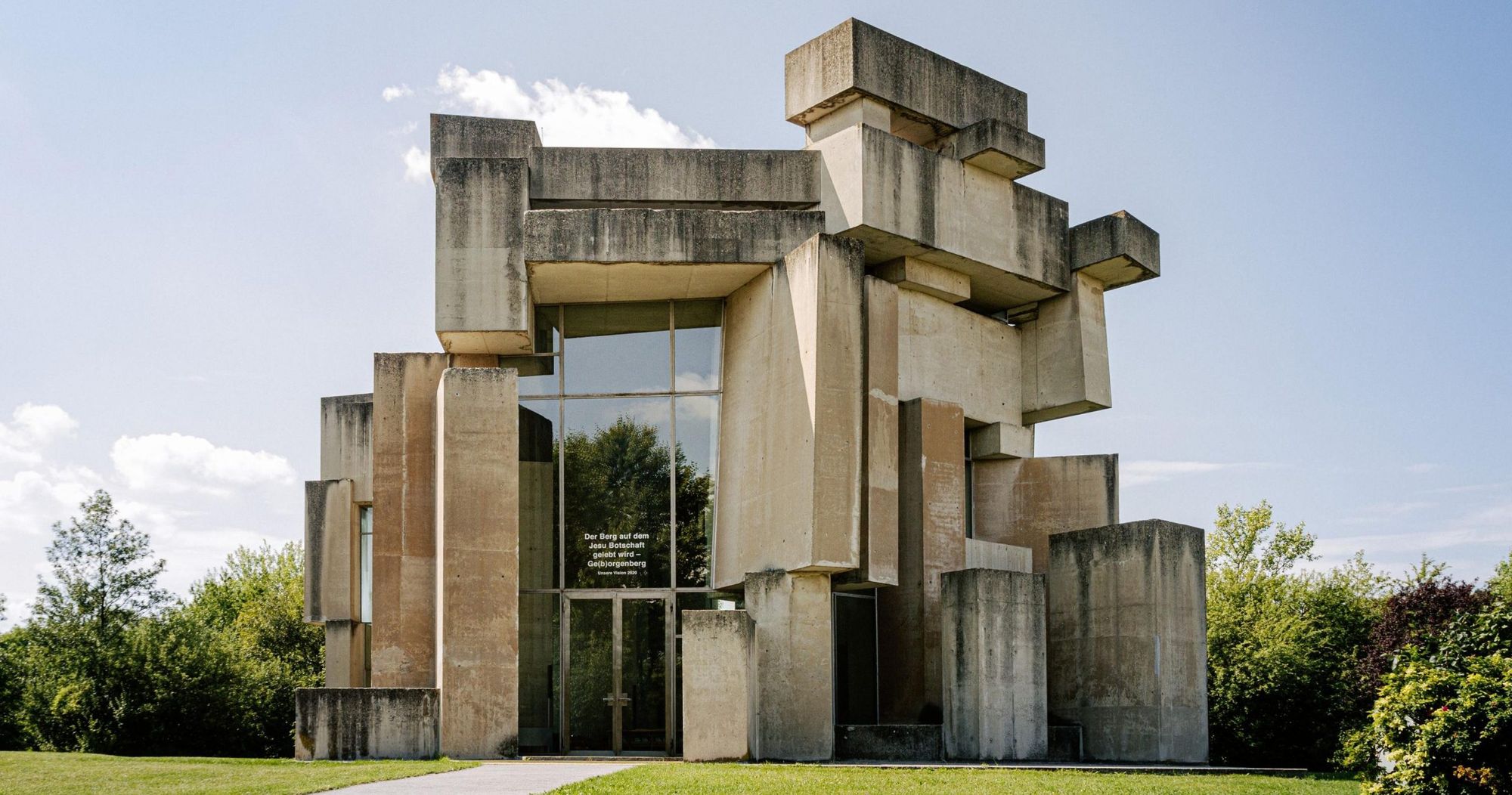 |
| A church in Austria. |
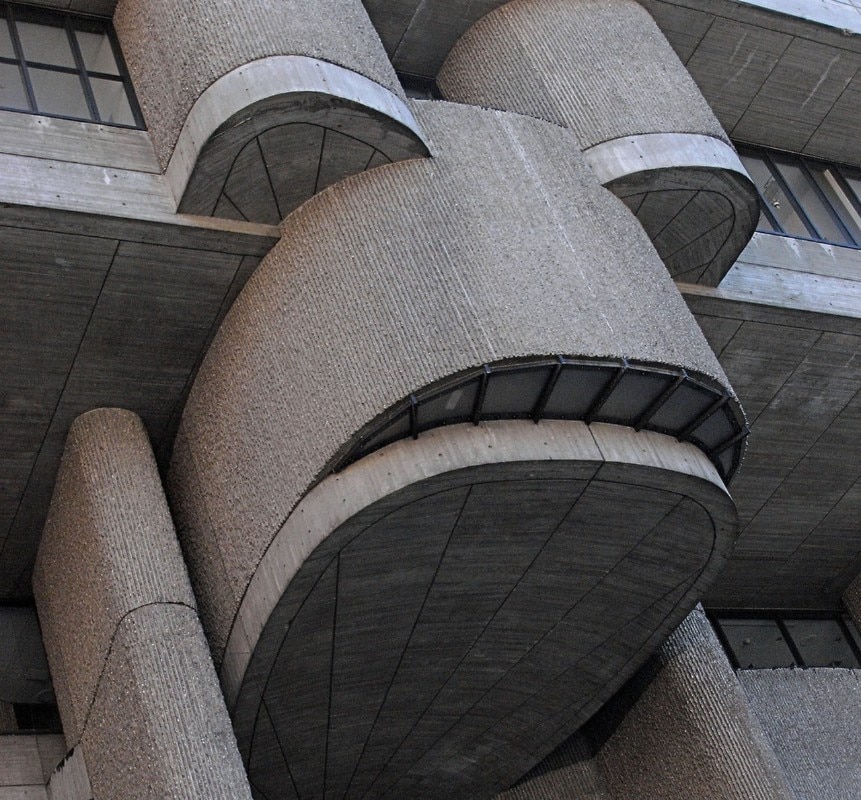 |
| A government centre in America. |
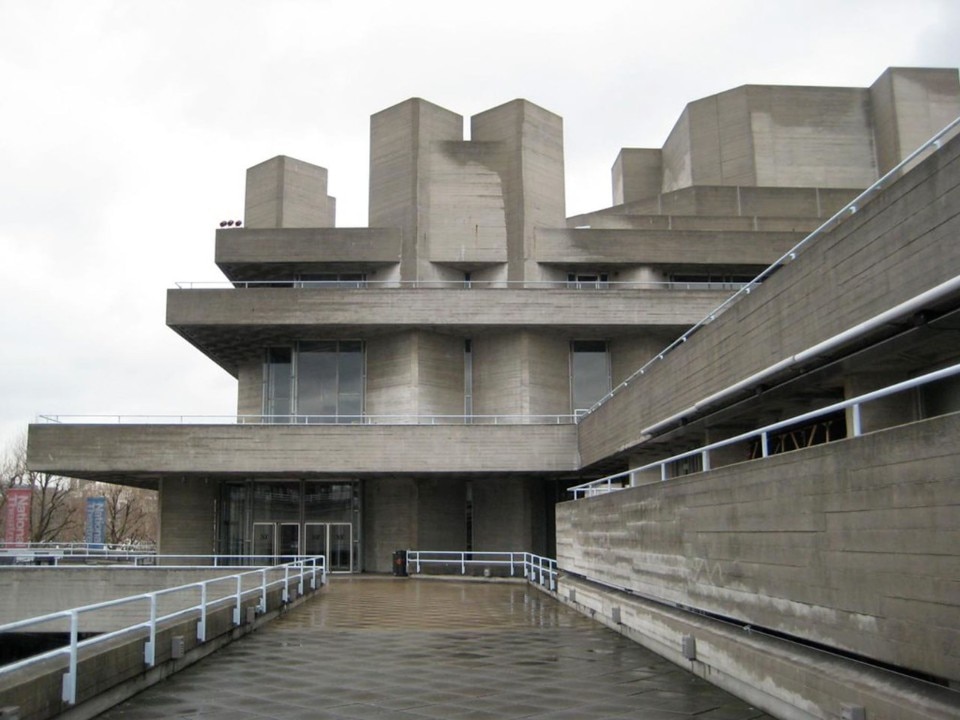 |
| A theatre in the UK. |
And finally, our very own RAU:

These big, grey and rough buildings made no effort to acquaint themselves with onlookers and to the war-torn countries(with their rails between their legs), picking up the pieces of their lives, the buildings conveyed one simple message: DO NOT MESS WITH US!
Just what a government on a Marshall Plan loves to see!
Now, let’s bring it home. Brutalism is described as “giving off a sense of permanence”, and it has sometimes been accused of being meant to stave off student protests in terms of campus architecture. Knowing that young people and university students tend to be more progressive and are more susceptible to being radicalised, it makes sense why an oppressive regime would want to create an anti-protest atmosphere for a group of their population that has the capacity to think freely, lots of energy and no jobs or homes to lose. Consider the role of young people in landmark uprisings all over the world: the Soweto Uprisings of 1976, the March For Our Lives protest of 2018 and the recent Gen-Z protests in Nepal. Young people are a unique asset or threat to any government.
Finally, having a chance to start a campus from scratch rather than inherit it from the English (such as UCT and Stellenbosch), the Apartheid government could build a university that expounded upon their most potent weapon… psychology.
The building of a university is a deeply philosophical endeavor (those philosophies being things such as societal impact, lieflong learning and striving to be a meaningful member of society) and so it makes sense that the financier of a university will impart their philosophies into the very fabric of the university as according to an article from the Journal of the South African Institute of Architects: “it is bound to be so because universities are built mainly by governments and will [so] reflect their thinking”. Rand Afrikaans Universiteit was no different in how it combined intimidation, stature, hostility and grandeur.
Campus design is integral to a student’s identity, and it contributes to their worldview post-university, as universities (and such, their designs) are incubators of thought and ideas. A campus that is so closed off, austere and unwelcoming is bound to impart the same worldview of aggression and supremacy onto its young students. The university was bound to produce a group of intellectuals who approved of and sought to maintain the discriminatory state of affairs at the time, which sought to stunt the success of Africans.
It is now 2025, 50 years later, and much has changed; the political structure of the country, the socio-economics of its inhabitants and the management of RAU itself have changed. Now, a man shall not be defined as inferior to another, nor shall any man be jailed for sitting next to another on the mere basis of skin, and of course, vehicles of exclusion like RAU no longer exist; it has been replaced by a metropolitan “University of Johannesburg”; its stripes of bright orange are scattered all over the Kingsway precinct where young 20 something year-olds of all colour, race and creed are teeming as they make their way to and from the new Rea Vaya BRT or the new Campus Square mall; yes much has changed… except the design of the building itself.
This is the point of the article where I try to tastefully shift my tone by declaring that the APK Campus building of the University of Johannesburg is indeed an engineering feat, and it is definitely among South Africa’s proudest architectural achievements, regardless of what it could have been conceived to convey. I also declare that the design of the APK Campus is effective in how it introduces itself and how it wants you to feel about it. Yes, it may seem as though I have spent the better part of your past 20 minutes bastardising the design of the building, but I have been merely trying to conscientise the reader to the power that campus architecture has and how that power could have been exercised in the case of RAU.
With that said, my true criticism lies with the current administration of UJ, and how it has barely made any effort to communicate its ethos via architecture.
To be fair, it’s important to note that UJ was born out of a merger, as the government combined three independent and somewhat unrelated institutions into one. These institutions were Technikon Witwatersrand, located in Doornfontein and Auckland Park (on Bunting Road), Vista University in located in Soweto and of course Rand Afrikaans University, located in Auckland Park (on Kingsway Road). It was 2003, and the then Minister of Higher Education, Kader Asmal, pointed at the previously mentioned institutions and said, “You, you and you, you are all one thing now, figure it out,” and so were the University of Johannesburg, Free State and Limpopo born (to name a few).
The aim was to provide a higher education climate that broke down the racially motivated ways of the previous administration and create an environment where everyone could have access to excellent education post-matric. As you can imagine, this was not an easy task!
Mergers of any kind are often complex and and one that sought to amalgamate three different organisations had alot on its plate to iron out such as fee structure, preferred curriculum, labour restructuring and equalising of all campus facilities…architecture was NOT high up on the list and understandably so; in one fell swoop, millions of Black kids were afforded opportunities to study programmes at institutions that did not really mean for them to become anything, who cares about “facades” and “remembering the school of Le Corbusier”?
It seems that that was the mentality of UJ in those early days, where they had to prove that a university attended and run by Black people could be successful. While doing research for this article, I stumbled across a 111-page “introductory” document published in 2009, in which UJ provides detailed insights into the events surrounding its inception and the many mountains it had to conquer between its establishment in 2005 and 2009 when the document was released. The document explores things such as legal ramifications, course clashes and unequally resourced campuses, as well as its inheritance of the awkwardly located East Rand campus that remains disjointed from UJ to this day; besides service upgrades, there is no mention of architectural improvements, all hands were on deck for technical advancements solely and to be fair, it was not in vainIn 2025, Times Higher Education ranked UJ #1 in South Africa and Africa and it is ranked 23rd globally. In 20 years, the university has gone from being a novel “rainbow-nation” ornament to being a continental juggernaut!
So you’ve proven yourself right? Earned your stripes and you’ve even managed to have less than 50% of your revenue come from state funding, so why not deal with things that make a student proud to be on campus?
In good faith, I consider that UJ inherited all of its campuses rather than pick sites and build from scratch like RAU did, and so I offer concession to the Doornfontein campus that was originally a mining school (equipped with an underground mine still in operation today) and the Bunting Road campus that was originally a teacher’s school and was later annexed into TWR but NOT for the Soweto campus.
You see, unlike the rest of UJ’s campuses that were largely untouched upon occupation in 2005, the Soweto campus received a handsome makeover six years later in 2011.
According to a Times Live article from the time, the campus was the recipient of new “student residences named after anti-apartheid icons such as Hector Pieterson, lecture halls, a student centre, law and health clinics, computer laboratories and sport amenities.” This is corroborated by a UJ Spatial Development Framework plan document from 2021 that explains that numerous additions have made to the original campus “creating new facades to the existing vista buildings, enhancement of the campus landscape and circulation routes, four student residences, library, The Braam Fisher and Robert Sobukwe academic buildings, and sports facilities” clearly indicating that the campus was overhauled and like any large scale revamp, especially that of a university campus, alot of thought went into it…but not architectural thought.
Pictured below is the former Vista Campus:
 |
| Note how, immediately upon arrival, the campus directs you to a central building that gives a sense of orientation and direction. The spatial design is frugal yet tasteful. |
Below is the new campus:
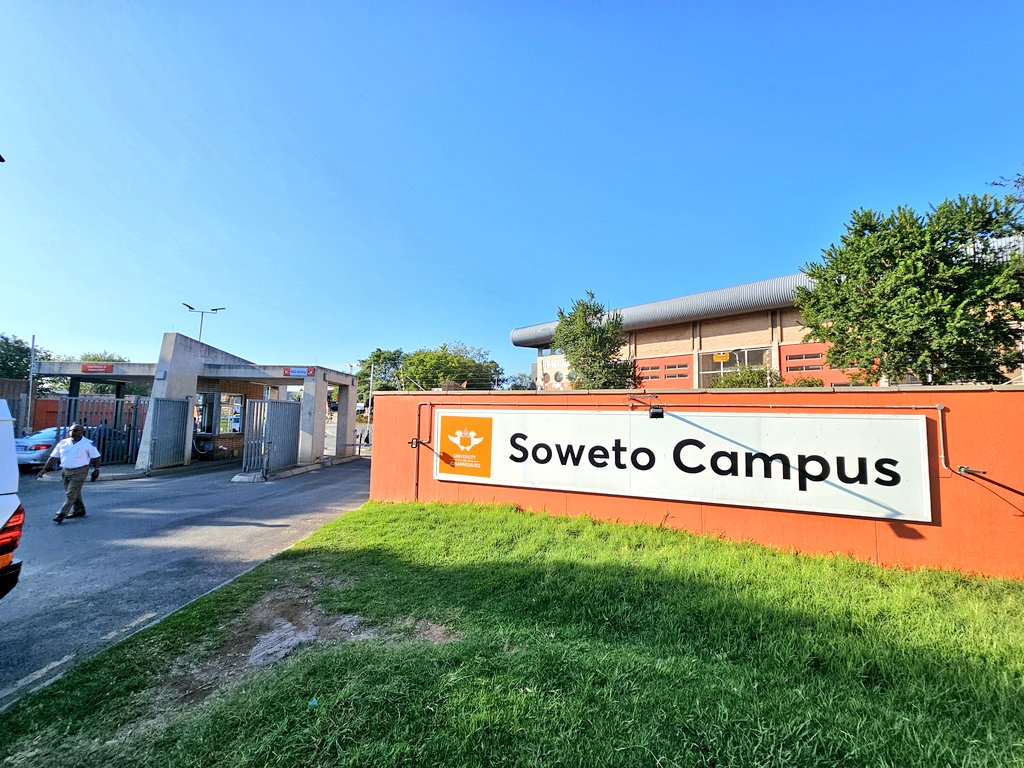 |
| Though the pictures are not from the same angle, you are not missing out on much. The entrance is just as oblivious of the building to the right as it is in this image, and the campus feels as dispirited as it does in the picture. |
Not very inviting, is it? The previous 1980s design, though under-resourced and built with shoddy materials (surprise), managed to set itself apart from any other surrounding building, i.e the teacher’s college next door.
In a study covering campus architecture, Combrinck writes, “the architecture endeavours to convey the importance of the institution and of the select few allowed to study there and conduct research there and convey importance is exactly what the former design did!
The new facade, however, is incoherent, and the campus has been demoted to looking like a quirky high school rather than a place where accountants and business professionals (these are the campus’s main offerings) are developed.
As a former student who frequented the campus, it was definitely the campus with the least character out of all UJ campuses, solely based on design. From the afterthought that is the pedestrian entrance to the arid parking lot that you are immediately ejected into upon entry, as well as the barely cohesive buildings surrounding the vista, the design of this new campus consists of many architectural oversights. The previously mentioned UJ SFD Plan puts it best: “...the university’s presence and identity on the road is typified by an unwelcoming concrete palisade fence… the physical face of the campus along Chris Hani Road is not very welcoming to the community and does not communicate a positive identity. The arrivals forecourt between the main gate and the second pedestrian gate is disorientating and unwelcoming.”
About the interior of the campus, the article had this to say: “The many dead building edges and profusion of fences between parts of the campus detract from the dignity and interactivity of the campus. In short, SWC is not a joy to learn in.
The Plan’s oversights or recommendations for the campus design include: embrace and celebrate the site's unique character, the slope, and local landmarks.
A significant proportion of first-year students who arrive at UJ are people who hail from rural or underserved communities in which they have never seen a building taller than 3 storeys before, much less gotten to experience the power of spatial design. If there’s one thing the first rector of RAU (who oversaw the design and construction of RAU) Gerrit Viljoen, got right, it is wanting the university to “say something about the Afrikaner who had just arrived in the city” for the UJ Soweto campus says nothing about the boy from Bochum or the girl from Phongola who has just arrived in Johannesburg, poised to be the thinkers of solutions that will benefit mankind.
To wrap up my little rant, architecture is a song a building sings to the eyes of those who aspire to live, work or study in it, and regarding campus architecture, it is the song that will remain in the minds of all the doctors, lawyers and teachers as they make this world a better place. I hope that the hot shots in our universities and colleges will no longer look at universities as factories of intellectuals and colleges as assembly lines of tradesmen, but as opportunities to preach the gospel of good spatial design to people who may never experience it outside of academia ever again.
Comments
Post a Comment